
By Clayton Cavalcante, Founder & Publisher
Updated: September 4, 2026
1. Quick Answer
The best dog ramp is the one that fits your vehicle, dog and handling constraints. Measure the vehicle’s actual contact height, check the dog’s actual weight against the current manufacturer rating, then compare deployed length, setup space, product weight and storage. Choose by fit, not by rank.
Choose PetSafe Happy Ride Extra Long Telescoping when adjustable length and the lower derived incline at full 87-inch extension are the leading fit constraints.
Choose PetStep Original Folding Pet Ramp when a fixed 70-inch folding format and high capacity eligibility fit the dog, vehicle and handler. Its 500-pound animal-use rating is an eligibility fact, not proof of greater safety, stability or durability.
Choose Pet Gear supertraX Bi-Fold PG9166GRSX when 13-pound portability is the priority and its 66-inch length and 150-pound rating pass the dog-and-vehicle fit check.
A ramp choice should not be treated as a veterinary prescription. Published canine biomechanics research shows that jumping, ramps, stairs and inclines can change forces, weight distribution or joint motion, but we found no evidence-based universal ramp angle that makes a commercial product categorically safe for every senior dog or every dog with orthopedic or neurologic disease.
2. Top Picks at a Glance
All three Published Picks passed the frozen product-evidence gate and the current manufacturer surfaces were rechecked in the CMS Freshness Gate. “Current US availability” means an active manufacturer product/order surface was verified; it does not mean every color or retailer listing is continuously in stock.
PetSafe Happy Ride Extra Long Telescoping
Best for vehicle-height flexibility.
Specifications: 47–87 in deployed; 20 in wide; 18 lb; 300 lb advertised load rating.
Mechanism / availability: Aluminum telescoping ramp; active manufacturer order surface confirmed in the Freshness Gate.
Fit: Adjustable length and lowest derived incline at full extension.
Anti-fit: Requires the most rearward deployment room; 18 lb to handle.
Evidence confidence: HIGH for current manufacturer specifications and availability; MODERATE for real-world fit until the owner measures the vehicle.
PetStep Original Folding Pet Ramp
Best heavy-duty folding route.
Specifications: 70 in deployed; 17 in wide; 18.5 lb; 500 lb advertised animal-use rating.
Mechanism / availability: Fixed bi-fold; active direct US order surface confirmed in the Freshness Gate.
Fit: Fixed folding route with high capacity eligibility.
Anti-fit: 18.5 lb; fixed length offers no deployment adjustment.
Evidence confidence: HIGH for current product-page specifications; MODERATE for real-world fit until vehicle and dog inputs are checked.
Pet Gear supertraX Bi-Fold PG9166GRSX
Best lightweight portability route.
Specifications: 66 × 16 × 4 in; 13 lb; 150 lb advertised load rating.
Mechanism / availability: Bi-fold with carry handle; active manufacturer product surface confirmed in the Freshness Gate.
Fit: Lightest handling route.
Anti-fit: Shortest and narrowest here; steepest derived incline at the same height; 150 lb eligibility ceiling.
Evidence confidence: HIGH for manufacturer-documented product attributes; MODERATE for real-world fit until owner-specific inputs are checked.
Manufacturer sources: PetSafe · PetStep · Pet Gear
3. How We Evaluated
We evaluated the products with an evidence hierarchy designed to keep product facts, derived geometry and clinical interpretation separate.
- Product attributes and current US availability: current manufacturer product pages and manuals control. Merchant copy, marketplace snippets and older specifications do not override the current manufacturer record.
- Vehicle contact height: vehicle OEM or established specification sources control. A generic vehicle-class assumption is not used as a substitute for an actual measurement.
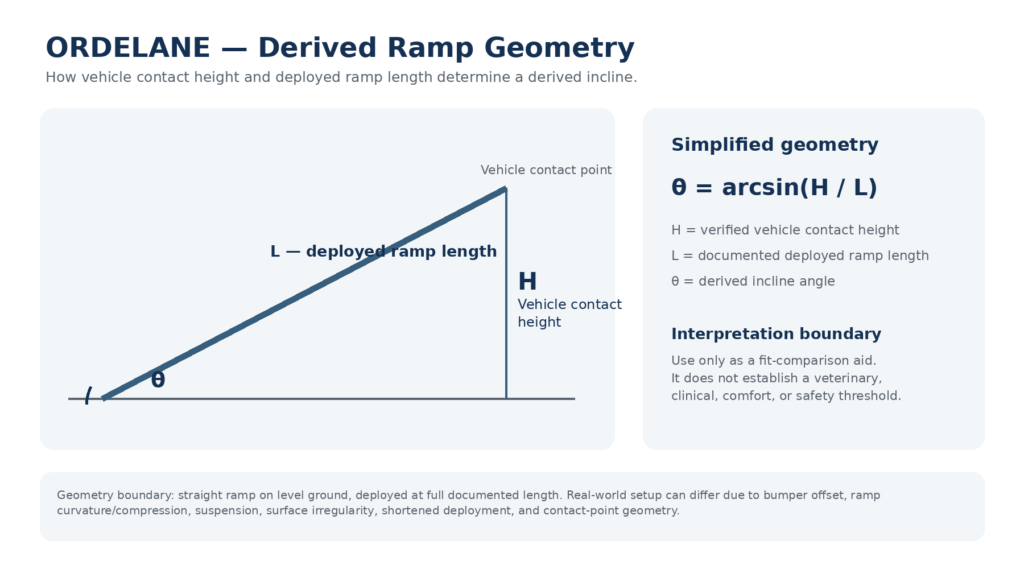
- Geometry: only verified contact height H and manufacturer-documented deployed length L are used in θ = arcsin(H/L). The result is a mathematical comparison, not a clinical safety rating.
- Dog eligibility: actual dog weight is compared with the manufacturer-advertised load rating. A higher rating does not automatically make a ramp the better choice.
- Handling and storage: product weight, mechanism, deployed length and the owner’s available storage/deployment space are considered without inventing durability or ease-of-use claims.
- Surface and interface: we report manufacturer-documented surfaces, edges, feet, grips and tethers. We do not convert marketing language into independent traction or stability proof.
- Mobility boundary: veterinary and biomechanics literature informs the limits of what can be claimed. It does not authorize a universal therapeutic angle or product prescription.
Evidence boundary: ORDELANE did not hands-on test these ramps. We did not independently test wet grip, surface wear, folding or telescoping failure modes, vehicle-edge compatibility, long-term durability, dog acceptance or handler ergonomics. Those remain real-world variables.
4. Vehicle-Height × Ramp-Length Comparison
Geometry boundary: For a straight ramp on level ground, deployed at its full documented length, the simplified angle is θ = arcsin(H/L), where H is the verified upper contact/support height and L is the deployed ramp length. The model does not include bumper offset, ramp curvature or compression, surface irregularity, a shortened deployment, or details of the top-contact geometry.
Figure 1. ORDELANE-owned geometry diagram. Generic vehicle/ramp geometry only; no product imagery or clinical threshold.
| Verified vehicle example / contact height | PetSafe 87 in | PetStep 70 in | Pet Gear 66 in |
|---|---|---|---|
| Subaru Trailseeker Premium AWD / 28.0 in | 18.8° | 23.6° | 25.1° |
| Subaru Crosstrek AWD / 30.7 in | 20.7° | 26.0° | 27.7° |
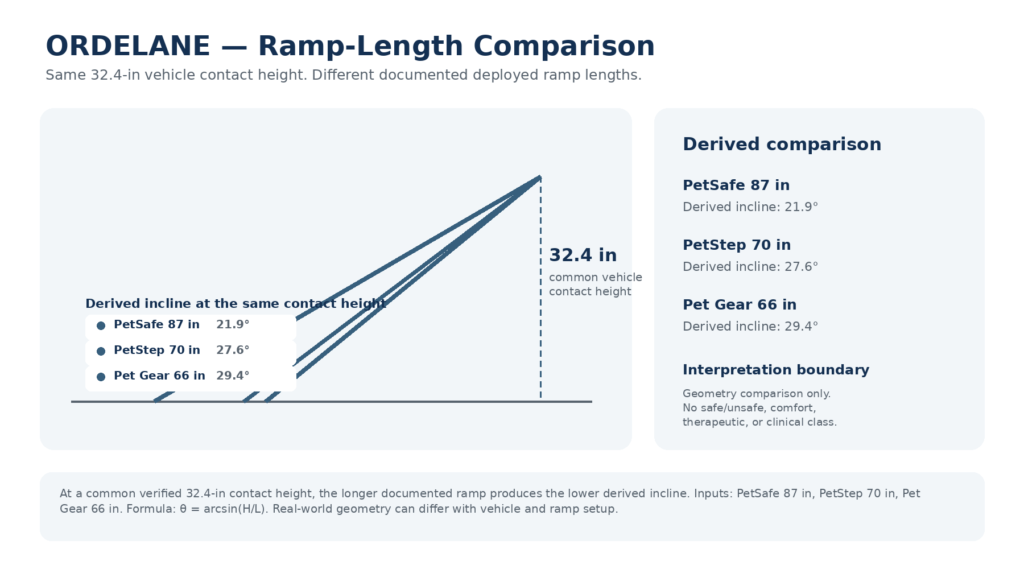
| Jeep Grand Cherokee Limited 4×2 / 32.4 in | 21.9° | 27.6° | 29.4° |
Vehicle specification sources: Subaru Trailseeker · Subaru Crosstrek · Jeep Grand Cherokee
At every verified height in this matrix, the fully extended 87-inch PetSafe ramp produces the lowest derived incline, the 70-inch PetStep is intermediate and the 66-inch Pet Gear is highest. That order follows directly from length at a common height. It does not establish that any row is safe, comfortable or therapeutic for a particular dog.
Figure 2. ORDELANE-owned comparison at a common verified 32.4-inch contact height. Longer length lowers the derived incline; no clinical safety claim is implied.
5. Detailed Reviews
PetSafe Happy Ride Extra Long Telescoping — Best for vehicle-height flexibility
Why it is a Published Pick. The PetSafe’s defining advantage is its 47-to-87-inch telescoping range. Full extension supplies more ramp length than either fixed folding option in this guide. At the same contact height, that translates into a lower derived incline. For owners who use more than one vehicle or who need to tune the deployment to a measured contact point, this is the clearest fit route among the three.
Verified product record. The current manufacturer page documents a 47-to-87-inch deployed length, 20-inch width, 18-pound product weight and 300-pound advertised load rating. It describes an aluminum telescoping mechanism, safety latch, high-traction walking surface and side rails. An older 400-pound figure appears in historical material, but the current 300-pound manufacturer rating controls this draft.
Fit. Choose this route when measured vehicle height and available rearward space make the adjustable length useful, and when an 18-pound ramp is manageable for the handler. PetSafe also provides manufacturer guidance that its extra-long version is intended for higher vehicle access; that guidance is useful for product selection but is not independent clinical evidence.
Anti-fit. At maximum extension, it needs the most rearward deployment room in this group. It is not the lightest option, and a telescoping form factor creates a different storage and handling routine than a bi-fold. We found no basis to claim that the mechanism resists dirt, sand or long-term wear better or worse than the others.
Evidence boundary. We did not hands-on test the walking surface, latch, telescoping action, edge interface or vehicle compatibility. The manufacturer’s surface description is not independent wet-grip evidence.
PetStep Original Folding Pet Ramp — Best heavy-duty folding route
Why it is a Published Pick. The PetStep is the fixed folding route for owners who first need high capacity eligibility and prefer a 70-inch bi-fold format. Its documented animal-use rating is 500 pounds. That number should be used to determine whether a particular dog is within the manufacturer’s stated limit, not as a proxy for overall quality or clinical suitability.
Verified product record. The current product page documents a 70-inch deployed length, 17-inch width and 18.5-pound product weight. A separate manufacturer FAQ has shown 17.5 pounds; the current product page controls here, and the discrepancy remains disclosed. The product uses a ridged rubberized walking surface, universal top grip and rubber feet.
Fit. The PetStep is the middle geometry route in every verified vehicle-height row: longer than the Pet Gear and shorter than the fully extended PetSafe. It may fit an owner who wants a folding mechanism, needs capacity well above 150 pounds and can manage an 18.5-pound unit.
Anti-fit. Its deployed length is fixed, so the owner cannot extend it to lower the derived incline or shorten it through a designed telescoping range. It is also the heaviest of the three by the current controlling specifications, though the PetSafe is close.
Evidence boundary. Manufacturer statements about arthritis, dysplasia, injury or recovery are not used as ORDELANE conclusions. We did not independently test its grip, folding joint, long-term durability, stability or compatibility with a specific vehicle edge.
Pet Gear supertraX Bi-Fold PG9166GRSX — Best lightweight portability route
Why it is a Published Pick. At 13 pounds, this Pet Gear model is the lightest of the three documented routes. That matters when the person who must lift, carry and store the ramp has a lower handling tolerance. The bi-fold format, carry handle and tether are also directly relevant to transport and setup.
Verified product record. The manufacturer documents a 66-by-16-by-4-inch format, 13-pound product weight and 150-pound advertised load rating. It also describes a removable pressure-activated supertraX mat, bottom grippers, raised edges, a safety tether and a carry handle.
Fit. Choose this route only after confirming the individual dog is within the 150-pound rating and the measured vehicle contact height produces a geometry the owner is willing to evaluate. Its lower product weight can be a decisive operational advantage when frequent loading and unloading is expected.
Anti-fit. It is the shortest and narrowest option in this comparison. At the same contact height, it therefore produces the steepest derived incline of the three. The 150-pound rating also creates a lower eligibility ceiling than the other picks.
Evidence boundary. The manufacturer’s traction language is not independent proof of wet, dusty or worn-surface grip. We did not hands-on test the mat, tether, grippers, hinge, raised edges, stability or dog acceptance.
6. How to Choose for Your Vehicle and Dog
- Measure the actual upper contact point. Park on level ground and measure vertically from the ground to the point that will support the top of the ramp. Do not substitute a generic SUV or pickup height.
- Check the dog’s actual weight. Compare the measured weight with the current manufacturer rating. Treat capacity as a pass/fail eligibility input, not a ranking score.
- Compare deployed length and derived geometry. For a straight, fully deployed ramp, calculate θ = arcsin(H/L). A longer ramp at the same height lowers the derived incline. If H is not verified, hold the calculation.
- Confirm deployment room, storage and handling. Check the rearward space needed for full deployment, the folded or retracted storage footprint, and whether the person using the ramp can safely carry its documented product weight.
- Choose the mechanism that fits the routine. Use telescoping adjustment when variable deployment length is the key constraint; use a fixed folding route when simpler fixed geometry and the folded storage pattern better fit the vehicle and handler.
- Apply the mobility boundary. Pain, weakness, a major gait change, recent surgery, diagnosed orthopedic or neurologic disease, or an active rehabilitation plan calls for individualized veterinary or rehabilitation guidance. Do not turn a calculated angle into a universal medical threshold.
7. Who This Guide Is For
This guide is for owners of cars, crossovers, SUVs or pickups who need to compare ramp length, vehicle contact height, dog weight, product weight, storage and mechanism using traceable inputs. It is especially useful when “best” depends on vehicle geometry and handling constraints rather than a single overall rank. Vehicle access is only one part of the travel setup; if restraint during the trip is also a concern, see our guide to crash-tested dog car harnesses.
It is not an argument that every healthy dog needs a ramp. We found no basis to claim that routine ramp use prevents future arthritis, intervertebral disc disease or injury in all dogs.
8. Who Should Not Rely on This Guide Alone
Do not rely on this guide alone when a dog shows pain, weakness, reluctance that may reflect discomfort, a new or major gait change, recent surgery, diagnosed orthopedic or neurologic disease, or a clinician-directed rehabilitation plan. A veterinarian or qualified canine rehabilitation professional can assess the dog’s diagnosis, strength, coordination and movement strategy in ways a product comparison cannot.
Do not rely on the geometry table when the vehicle’s actual support height has not been measured, the ramp cannot be deployed to its documented length, the top contact is unstable, the ground is uneven, or the product is used outside the manufacturer’s instructions. Those conditions break the simplified model.
9. FAQ
How should I measure an SUV or truck for a dog ramp?
Measure vertically from level ground to the actual point that will support the top of the ramp. Measure the vehicle and configuration you will use, not the nominal class of the vehicle. Then confirm that the chosen ramp can deploy to its documented length within the available space.
Does a longer ramp create a lower incline?
Yes, when the upper contact height stays the same and both ramps are modeled as straight and fully deployed. Under those conditions, increasing L in θ = arcsin(H/L) lowers the derived angle. This is a geometry statement, not a clinical safety guarantee.
What ramp length do I need?
There is no single length for every vehicle. Start with the measured contact height, compare available deployed lengths, calculate the simplified geometry and confirm that the vehicle surroundings provide enough space. Then check dog weight, handling, storage and mobility constraints.
Is a 20–25° ramp safe for senior dogs?
We found no evidence-based universal angle that makes a ramp categorically safe for every senior dog. Age alone also does not describe pain, strength, coordination or diagnosis. Use the angle as a transparent geometry input and seek individualized veterinary guidance when mobility impairment or disease is present.
Is a 500-pound rating automatically better?
No. The rating first tells you whether the dog is within the manufacturer’s stated load limit. Once the dog is eligible, the decision still depends on vehicle height, deployed length, handling, storage, interface and the evidence limits. Capacity alone does not prove stability, durability or clinical superiority.
Is a folding ramp better than a telescoping ramp?
Neither mechanism is universally better. A telescoping ramp can vary deployed length, which may help with multiple vehicle heights or constrained setup. A folding ramp has fixed deployed geometry and a different storage shape. The better route is the one that fits the measured vehicle, dog and handler routine.
Are ramps better than stairs for senior or mobility-limited dogs?
Research in healthy dogs shows that stairs, ramps and inclines can produce different limb motions and loading patterns, but those findings do not prescribe one device for every impaired dog. Diagnosis, strength, coordination and the actual device geometry matter. Use veterinary or rehabilitation guidance for a mobility-limited dog.
Can a dog ramp prevent arthritis, IVDD or injury?
We did not find evidence that supports a universal prevention claim for these products. A simulated vehicle-jump study measured higher peak forelimb ground-reaction forces at greater jump heights in healthy dogs, but it did not establish that a particular commercial ramp prevents disease or injury.
10. Final Verdict
Choose by fit, not by rank. Start with the actual vehicle contact height and the dog’s actual weight, then compare deployed length, derived geometry, deployment room, product weight, storage and mechanism.
- Choose PetSafe Happy Ride Extra Long Telescoping when adjustable length and lower derived incline at full extension are the leading fit constraints—and when the vehicle provides the required deployment room.
- Choose PetStep Original Folding Pet Ramp when a fixed 70-inch folding route and high capacity eligibility fit the dog, vehicle and handler—and when an 18.5-pound ramp is manageable.
- Choose Pet Gear supertraX Bi-Fold PG9166GRSX when lightweight portability is the leading operational constraint—and only after the 150-pound rating, shorter length and narrower width pass the dog-and-vehicle fit check.
If the vehicle contact height is not verified, the dog is outside the current manufacturer rating, or pain, weakness, recent surgery or diagnosed disease changes the mobility question, hold the product decision. The next step is measurement or individualized clinical guidance, not a stronger marketing claim.
About the Publisher
Clayton Cavalcante is the Founder and Publisher of ORDELANE. He oversees the publication’s research standards, evidence boundaries, editorial methodology, and final publication decisions.
Sources & Evidence Notes
Product specifications and availability
- PetSafe — Happy Ride Extra Long Telescoping Dog Ramp
- PetStep — Original Folding Pet Ramp
- Pet Gear — supertraX Bi-Fold PG9166GRSX
Veterinary and biomechanics literature
- Peak forelimb ground reaction forces in dogs jumping from a simulated car boot
- Differential mass support in dogs
- Hind-limb kinematics during therapeutic exercises in dogs with hip osteoarthritis
- Forelimb range of motion during stair and ramp ascent
- Thoracic-limb kinematics during stair and ramp descent in healthy dogs
Evidence note: the clinical literature supports boundary-setting and explains why movement context matters. It does not validate a universal safe incline, a disease-prevention claim or the clinical superiority of any Published Pick.